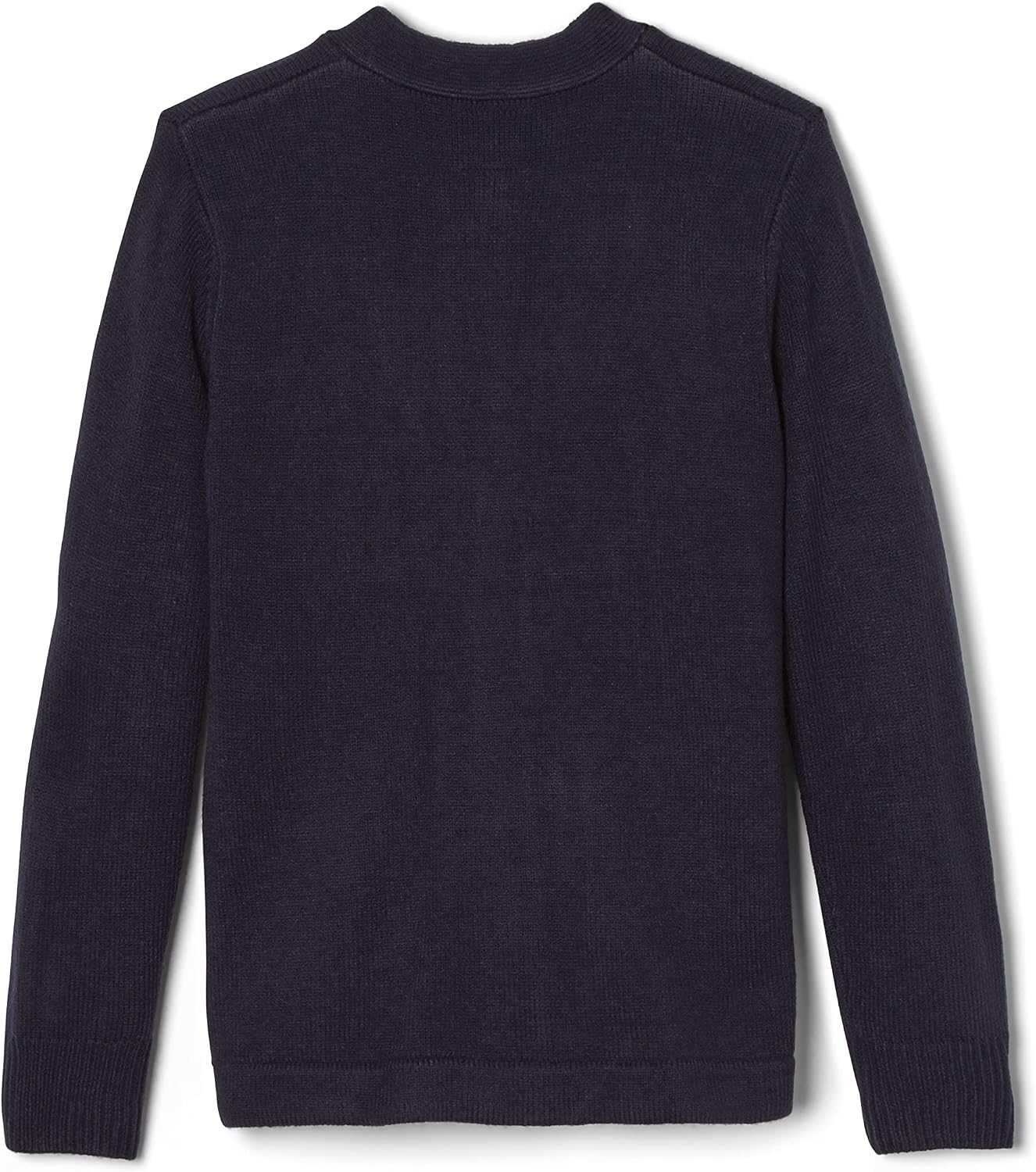
If you’ve ever pulled a school cardigan out of the dryer in October and found something that now fits your child’s younger sibling, you already know the problem. A cardigan — the button-front knit sweater that most private and parochial schools list as a required layering piece over the polo or dress shirt — sounds like the simplest uniform item to buy. It’s just a sweater. But uniform cardigans occupy a surprisingly wide quality range, from thin, fast-fading basics that pill (develop fuzzy little balls of fiber on the surface) within two months, to structured midlayer pieces that hold their shape and color through June. This guide breaks down what actually separates a sweater that survives a full school year from one that becomes a Friday-only backup by Thanksgiving — and ends with a clear decision rule so you know exactly which tier to buy for your situation.
Why Cardigan Durability Is More Complicated Than It Looks
Walk into any uniform shopping event in August and you’ll see cardigans priced from about $18 all the way past $85. The price spread isn’t random, but it’s not always honest either. Here’s what’s actually driving the difference.
Fiber Content Is the Foundation
The label sewn into the neck — the one most people cut out immediately — is the single most predictive piece of information on the garment. Uniform cardigans fall into roughly three fiber categories:
100% acrylic (or acrylic-dominant blends): These are the workhorses of the entry-level tier, typical of French Toast and most store-brand school basics. Acrylic holds dye reasonably well in the first season, machine-washes without shrinking, and costs less to produce. The tradeoff: acrylic fibers break down under repeated friction faster than natural fibers, which is why pilling at the elbows and underarms appears early. Good Housekeeping’s Institute textile guidance notes that acrylic’s abrasion resistance is lower than wool or wool-blend alternatives at comparable weights, which translates directly to visible wear by mid-year on an active child.
Cotton or cotton-blend knits: Cotton cardigans breathe better than acrylic and feel softer against a dress shirt collar, which matters when a child is wearing the layer for six or seven hours. The durability concern with cotton is shrinkage — even “pre-shrunk” cotton knits can shift a full size after repeated hot-water cycles if parents aren’t careful — and a tendency to stretch at the buttonband and cuffs over time. Dennis Uniform’s cotton-blend school cardigans address this partly through a ribbed cuff construction, which recovers better than a plain-knit edge.
Wool or wool-acrylic blends: This is the territory of Flynn O’Hara, Trutex, and heritage-tier suppliers. A 50/50 wool-acrylic or 70/30 wool-polyester blend gives you wool’s natural resilience — fibers that crimp back to shape after compression — combined with synthetic fiber’s dimensional stability in the wash. These cardigans pill less, hold their structure at the shoulders, and maintain color fidelity longer. The tradeoff is price ($55–$120 range) and a “dry clean or cold delicate” care requirement that not every family wants to manage.
Construction Signals That Are Easy to Miss at Point of Purchase
Fiber content explains a lot, but construction details determine whether a cardigan actually wears out gracefully or falls apart at the stress points. Three things to check before you buy:
Buttonband stability. Pull the button placket (the reinforced strip where the buttons are sewn) gently sideways. On a well-made cardigan, it barely moves. On a thin acrylic basic, it stretches several inches — a preview of exactly what happens after the first fifty button-and-unbutton cycles.
Shoulder seam placement. The seam connecting the sleeve to the body should sit at the bony top of the shoulder, not forward of it. A dropped shoulder seam (set back toward the arm) is a cost-cutting pattern choice that increases pull-stress on the seam during normal arm movement. Consumer Reports’ school clothing durability guidance consistently identifies shoulder seam integrity as a leading factor in early garment failure for active kids.
Cuff and hem rib weight. Heavier rib (visibly thicker banded edges at the wrist and hem) recovers better after stretching. Thin ribs — common on budget cardigans — lose their elasticity by winter and leave the sweater looking permanently baggy at the edges.
The Quantity Problem Most Families Underestimate
Before you lock in a per-piece decision, run the rotation math. This is where many families get burned.
By the numbers:
| School days per week with cardigan required | Cardigans needed for a two-wash-per-week cycle | Cardigans needed for a weekly wash cycle |
|---|---|---|
| 5 days | 2 | 3–4 |
| 3 days (block schedule) | 2 | 2 |
| 5 days, outdoor activities | 3 | 4–5 |
The Guardian’s education reporting on uniform costs found that families who bought the minimum recommended quantity (typically one or two cardigans) spent significantly more by February replacing worn or damaged pieces than families who purchased three at the start of the year. The cost-per-wear math almost always favors buying one more cardigan than you think you need in August.
This also affects your tier decision. If you’re buying three cardigans, the per-unit price difference between a $22 acrylic basic and a $58 wool-blend mid-tier is $108 total — meaningful, but spread across a full year of daily wear, the wool-blend is the better value if it holds for two school years instead of one.
Tier-by-Tier Breakdown: Where Each Level Actually Makes Sense
Entry Tier ($18–$32): French Toast, Generic Approved-List Basics
Who it’s for: Families on a strict budget, younger children who are hard on clothes and growing fast enough that fit will be the limiting factor before durability is, or situations where the school’s approved list is so restrictive that the entry-level vendor is the only compliant option.
What owners consistently report: Adequate for one school year when washed in cold water on a gentle cycle. Pilling is visible by month three to four at friction points. Color holds better in navy than burgundy or forest green. Size up one if you’re between sizes — the acrylic blends shrink slightly even on cold.
The tradeoff to name explicitly: If your child is in fifth grade or above and their cardigan is visible in formal assembly photos, team photos, or meets-the-headmaster situations, entry-tier acrylic reads visibly cheaper in photographs and in person. For younger grades or casual daily wear, it’s largely invisible.
Mid-Tier ($33–$65): Lands’ End School, Dennis Uniform
Who it’s for: Most families buying for grades 3–8, anyone who needs the cardigan to serve for two years, and schools where the cardigan is a daily visible piece rather than just a warmth layer.
What owners consistently report: The Lands’ End School cardigan in particular draws consistent praise in parent reviews for holding its shape at the shoulder and cuff through repeated washing — reviewers frequently note they’re still using the same cardigan in year two without visible degradation. Dennis Uniform’s mid-tier options in cotton-acrylic blends are reported to run slightly slim in the body, so checking the brand’s size chart against actual chest and sleeve measurements (not age) matters here.
Forbes’ coverage of children’s clothing value notes that the $45–$65 band for school staples typically represents the best cost-per-year value for items that need to last eighteen to twenty-four months under regular wear.
The tradeoff to name explicitly: Mid-tier cardigans usually don’t carry school crests unless you’re ordering through your school’s approved program — and crested versions often add $15–$25 to the base price. If your school requires a crest on the cardigan (check the handbook language carefully — “school colors” and “school crest” are not the same requirement), factor that into your budget before comparing prices.
Heritage Tier ($66–$120+): Flynn O’Hara, Trutex, Ramsdens
Who it’s for: Upper school students (grades 9–12) whose cardigans will be worn formally and photographed regularly; families outfitting for schools with strict heritage-uniform programs; grandparents or gift-givers purchasing a single high-quality piece; and any situation where the cardigan is part of a coordinated formal uniform kit.
What owners consistently report: Flynn O’Hara’s wool-blend school cardigans are frequently described in parent forums as “the last cardigan we bought” — meaning one purchase carries through multiple school years with no visible quality drop. Trutex (a UK heritage supplier with North American distribution) is noted for consistent sizing across seasons, which matters when you’re reordering the same item for a younger sibling years later.
The tradeoff to name explicitly: Heritage-tier cardigans require more careful laundering. If your household’s realistic laundry workflow is “everything goes in together on warm,” a $95 wool-blend cardigan is a poor fit for your actual routine regardless of its quality ceiling. Be honest about this before spending up.
If X, Then Y: Your Decision Rule
This is the framework to apply once you’ve confirmed your school’s compliance requirements:
If the cardigan is a warmth layer only (worn under a blazer, not visible in formal settings, child is in grades K–4): buy entry-tier acrylic in your school’s required color, size up half a size, buy two minimum.
If the cardigan is a daily visible uniform piece (worn without a blazer, child is grades 3–8, you need it to last more than one year): buy mid-tier cotton-acrylic or acrylic-blend from an approved-list vendor, check the actual size chart against measurements, buy three if the school requires it five days a week.
If the cardigan is part of a formal or heritage uniform program (upper school, assembly-visible, crested, or you’re buying as a significant gift): buy heritage-tier wool-blend from Flynn O’Hara, Trutex, or your school’s designated heritage supplier. Verify the care label before purchase and commit to the laundering routine that label requires.
If you’re in between tiers: The mid-tier almost always wins on cost-per-year math. The entry tier’s apparent savings evaporate if you’re replacing it before April. The heritage tier’s premium is only justified when the cardigan will actually be laundered correctly and worn in contexts where the quality is visible.
One last thing worth checking before you finalize: pull up your school’s uniform handbook and search for the specific word “cardigan.” Some schools use “v-neck jumper” (British-derived terminology for a V-neck pullover sweater — a different silhouette than a button-front cardigan), and buying the wrong style means starting over regardless of quality tier. Getting the right garment in the right quality for your situation is the whole job — and now you have the framework to do it.