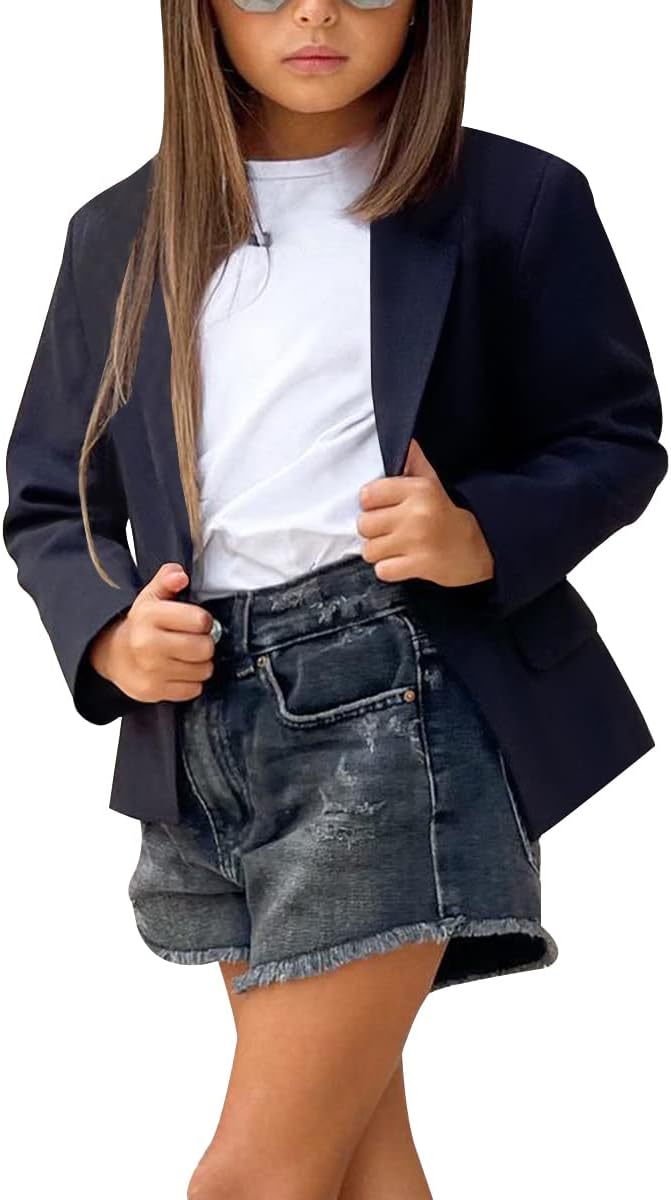
You got a letter from the school in late July. Somewhere in the dress code section — probably buried after three paragraphs about shoe color — you hit the phrase “No. 2 Dress uniform required for assembly days.” If you’re new to private or parochial school life, that phrase probably stopped you cold. Here’s what it means: most schools with layered dress codes assign a number or letter to each formality tier. “No. 1 Dress” is usually the most formal (think white gloves and crested blazers for graduation). “No. 2 Dress” — the tier this guide focuses on — is the polished-but-practical level required for chapel, visiting days, competitions, and formal assemblies. For girls, it almost always means a blazer or suit jacket (a tailored, structured outerwear piece worn over the uniform blouse or polo) in the school’s approved color, often with the school crest embroidered on the breast pocket. What follows is a level-headed comparison of the blazer and jacket options available from major approved vendors, the tradeoffs you’re actually weighing, and a clear decision framework so you’re not guessing when you hit checkout.
What “No. 2 Dress” Actually Requires — and Where Schools Vary
Before you spend a dollar, re-read your school’s handbook language carefully. The National Association of Independent Schools (NAIS) Dress Code Policy Survey Summary from 2024 found that dress code terminology varies significantly across institutions — “No. 2 Dress,” “Class B Uniform,” “Academy Formal,” and “Semi-Dress” are all used to describe functionally similar requirements, but the specific garment rules differ school to school.
The key questions to answer before buying:
1. Does the school require a crested blazer, or will a plain blazer in the approved color suffice? Crested blazers (with the school’s embroidered or woven crest on the left breast pocket) are typically required at schools with longer heritage traditions. Plain blazers in an approved navy, black, or burgundy are accepted at schools with newer or less tradition-heavy programs. This is not a minor distinction — crested blazers usually must be sourced from the school’s specific approved vendor, and substitutions will get sent home.
2. Is the requirement a true blazer (structured, with a lining and lapels) or can a suit-style jacket or “uniform jacket” qualify? Some dress codes accept a suit jacket — a slightly softer-constructed piece — as equivalent to a blazer for No. 2 purposes. Others explicitly require a “school blazer” with a formal lapel. If the handbook is ambiguous, email the uniform coordinator before purchasing. One returned blazer costs more in time and shipping than the email takes.
3. What is the approved color, and does it need to match existing pieces? Navy is the most common approved blazer color across U.S. private schools, followed by black. Burgundy, forest green, and grey appear at specific institutions. If you’re buying mid-year or replacing a lost piece, bring a swatch or order a fabric sample before committing to a full piece — navy varies more than you’d expect between vendors.
The Vendor Landscape: What Each Major Player Actually Offers
Here’s where the decision gets concrete. The major players in the girls’ school blazer category operate in meaningfully different parts of the market.
Flynn O’Hara — Heritage Blazers and Crested Programs
Flynn O’Hara is the vendor most associated with crested school blazers in the U.S. market. Their school-specific programs allow schools to register a proprietary crest that Flynn O’Hara then embroiders on blazers sourced through the school’s approved list. Per Flynn O’Hara’s School Uniform Catalog and Size Guide for 2025–2026, their girls’ blazers are available in ponte and wool-blend constructions, with the wool-blend running approximately $120–$175 depending on the school’s tier agreement.
The tradeoff: If your school has a Flynn O’Hara program, this is often a required purchase rather than a choice. The quality construction holds up well across multiple years per parent reviews aggregated on school community forums, but the sizing runs slim through the shoulders — a known pattern families report when ordering for athletic builds or girls transitioning from junior to misses sizing. Order early and plan to size up one if your daughter is between sizes.
Dennis Uniform — Mid-Range Value With Solid Construction
Dennis Uniform’s girls’ blazer line sits in the $65–$110 range and is frequently listed on approved vendor programs as the “value-tier” blazer option alongside a higher-priced heritage alternative. Per Dennis Uniform’s Product Specifications and School Program Documentation for 2025–2026, their blazers are offered in a polyester-rayon blend construction with a partial lining, in navy and black.
The tradeoff: The polyester-rayon blend is more wrinkle-resistant than wool and survives the wash-at-home cycle that most families prefer. The construction is noticeably less structured at the lapels and shoulders compared to Flynn O’Hara’s wool-blend pieces — which matters if your school’s No. 2 Dress occasions are high-visibility (graduation ceremonies, trustee meetings, competitive debate). For weekly assembly wear, the construction holds up appropriately and the cost difference is real money.
Lands’ End School — Softshell and Ponte Options for Everyday Formality
Lands’ End School, per their Uniform Buying Guide and Care Instructions for 2025–2026, offers girls’ uniform blazers in a ponte knit construction that bridges the blazer and cardigan categories. These run approximately $55–$80 and are machine-washable.
The tradeoff: The ponte construction reads as “blazer-adjacent” — it satisfies No. 2 Dress requirements at schools that allow knit-structured jackets, but will not satisfy programs that specify a woven blazer with formal construction. Check your handbook’s language against the Lands’ End School product description carefully. Where it is approved, families report excellent durability and comfort, especially for younger girls who find structured wool blazers uncomfortable during long assembly programs.
Trutex — British Heritage Construction for Traditional Programs
Trutex Ltd. is a U.K.-origin schoolwear manufacturer whose products appear on the approved lists of U.S. schools with British heritage affiliations or headmasters who trained in the U.K. system. Per Trutex’s Girls’ Schoolwear Technical Specifications (published product documentation), their blazers are offered in a worsted wool (a tightly woven, smooth-finish wool fabric) with a full lining, in traditional school colors including navy, black, and bottle green. Pricing runs $130–$200+ depending on import and vendor margin.
The tradeoff: Trutex blazers are recognized immediately by school administrators familiar with British schoolwear — the cut, the lapel, and the lining quality are distinctly traditional. They are the appropriate choice for schools running British-heritage programs or International Baccalaureate institutions where presentation standards mirror U.K. independent school norms. For American families encountering Trutex for the first time, the sizing is British (measured in inches chest, not U.S. numeric sizing) and the care requirement is dry-clean-only — both factors that affect the total cost of ownership over a school year.
By the Numbers: Blazer Options at a Glance
| Vendor | Construction | Approx. Price | Washable at Home | Best For |
|---|---|---|---|---|
| Flynn O’Hara | Wool blend / ponte | $120–$175 | Spot-clean / hand wash | Crested programs, heritage schools |
| Dennis Uniform | Poly-rayon blend | $65–$110 | Yes | Value-tier approved programs |
| Lands’ End School | Ponte knit | $55–$80 | Yes | Schools accepting knit-construction |
| Trutex | Worsted wool | $130–$200+ | Dry-clean only | British-heritage / IB programs |
Fit, Sizing, and the One Mistake Most Families Make
Sizing is where the most returns happen, and the pattern is consistent: families who order a blazer in the same size as their daughter’s polo or blouse end up with a piece that’s tight through the shoulders or too short in the sleeve.
Blazers are designed to be worn over a blouse, dress shirt, or polo — which means you need at least one inch of clearance through the chest and shoulders relative to the underlying layer. The practical advice from multiple school uniform coordinators (cited in school program onboarding documentation from Flynn O’Hara’s school partner network) is to measure your daughter while she’s wearing her standard uniform blouse, then use that measurement against the blazer size chart — not her bare-arm measurement.
For girls in a growth year (roughly ages 10–13), consider sizing up one — a blazer that fits perfectly in September may be short in the sleeve by February. A longer sleeve can be cuffed once for formal occasions without looking sloppy. A blazer that no longer reaches the hip is unwearable for formal assembly regardless of how much you’ve spent.
The Decision Framework: If X, Then Y
This is where you stop comparing and start buying. Run through these in order:
If your school lists a specific vendor and crest number in the handbook → Buy from that vendor only. There is no approved substitute. Budget for Flynn O’Hara or Trutex pricing and order before August 1 — custom crest programs close their order windows 6–8 weeks before the school year starts, and backorders routinely push into October.
If your school lists an approved color but not a vendor → You have flexibility. For a high-visibility No. 2 Dress program (formal assemblies, competitions, college interview days), the Flynn O’Hara wool-blend or Trutex worsted wool is worth the cost premium. For weekly low-stakes assembly wear, Dennis Uniform’s poly-rayon construction delivers adequate formality at roughly half the price.
If your school’s handbook language is vague about construction → Email the uniform coordinator with a direct question before purchasing. Ask specifically: “Does the No. 2 Dress blazer requirement accept a knit ponte construction, or is a woven blazer with lapels required?” That one email prevents a $90 return.
If your daughter is between junior and misses sizing, or in a visible growth phase → Order from a vendor with a documented exchange window (Lands’ End School and Dennis Uniform both carry this). Avoid finalizing a Flynn O’Hara crest order without first measuring over the blouse, since crested blazers are harder to return once embroidery is applied.
If budget is the primary constraint → Dennis Uniform for woven construction, Lands’ End School for ponte construction. Both are approved on a wide range of school programs and both survive home washing — which matters for a piece that goes on every assembly day across a 38-week school year.
The cost-per-wear math is worth a moment here: a $150 Flynn O’Hara blazer worn twice weekly across 36 formal-occasion weeks costs approximately $2.08 per wear in year one. If it survives two school years — which owners of the wool-blend construction consistently report — that drops to $1.04. A $70 Dennis Uniform blazer that lasts one school year runs about $0.97 per wear. The gap closes faster than the sticker price suggests, which is the reason school uniform coordinators consistently defend the higher-tier vendors to budget-conscious families. The right answer depends on your daughter’s grade, her growth trajectory, and how formal your school’s No. 2 occasions actually are — not on the price tag alone.