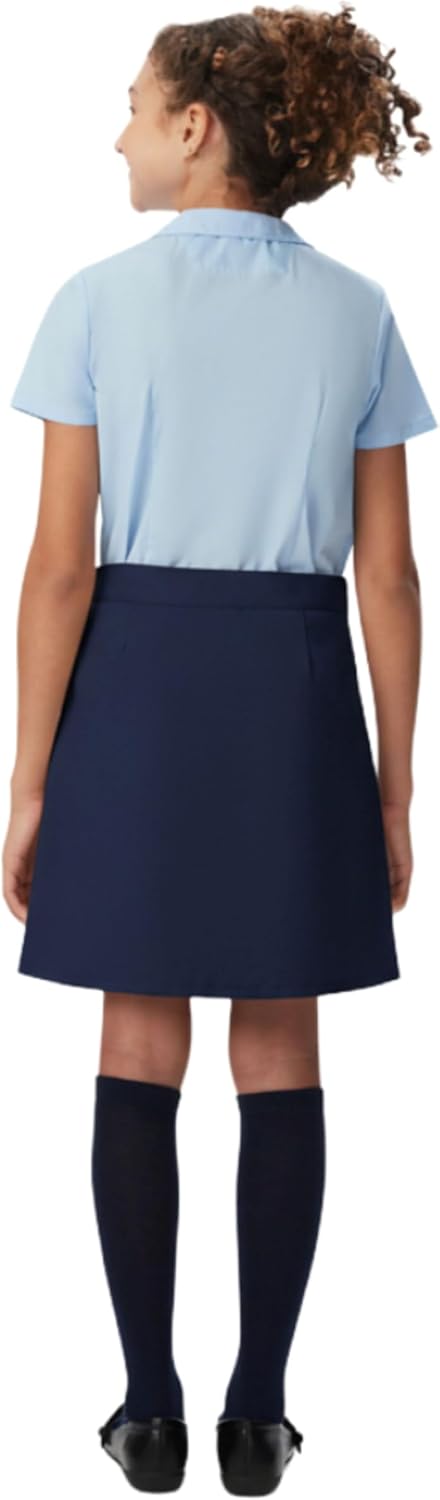
Picture this: it’s a Tuesday evening in late September. Backpacks are dumped by the door, your daughter’s only two clean uniform skirts are both in the wash, and picture day is tomorrow. You either scramble through a panic-dry cycle, dig out last year’s skirt that’s now two inches too short, or send her in the wrong thing and hope the teacher doesn’t notice. None of those options is good. The fix is almost embarrassingly simple — you just needed one or two more skirts at the start of the year. But how many is actually enough?
A uniform skirt (or uniform skort — that’s a skirt with built-in shorts underneath, common in lower grades) is one of those items that looks inexpensive on a per-piece basis but quietly becomes a problem when you under-buy. This article gives you a practical, laundry-cycle-based framework for calculating the right quantity for your daughter’s specific school week and your household’s laundry habits — no guesswork, no August panic.
| EDITOR'S PICKThe Children'S Place Girls Pont… | Mid-tierFrench Toast Girls' Pleated Ski… | Budget pickFrench Toast Girls' Adjustable… | |
|---|---|---|---|
| Style | Skort | Pleated | Scooter skirt |
| Waist type | Pull on | — | Adjustable waist |
| Pack size | 2-pack | — | — |
| Material | Ponte knit | — | — |
| Price | $24.98 | $14.99 | $7.47 |
| See on Amazon → | See on Amazon → | See on Amazon → |
Why “Two Skirts” Is Almost Always Wrong
The two-skirt default is the most common uniform-quantity mistake families make, and it’s completely understandable. You see a $22 plaid skirt on the approved vendor list, you think we’ll just wash it over the weekend, and you order two.
Here’s the problem with that logic: a typical household doing laundry every five to seven days — which Good Housekeeping’s household survey data identifies as the most common laundry cadence for families with school-age children — leaves almost no buffer. If your daughter has a muddy afternoon at recess on Wednesday and a class trip on Friday, your two-skirt inventory collapses fast.
The two-skirt assumption also ignores a few practical realities that experienced uniform parents know well:
- Skirts rotate out of regular wear faster than polos. A pleat gets permanently pressed wrong, a hem starts to fray, or the waistband elastic softens. That skirt stays in the drawer as a “backup” that never actually gets worn.
- Growth spurts don’t wait for a convenient moment. A skirt that fits in September may be clearly too short by December. Parents.com’s capsule wardrobe guidance notes that girls ages 6–12 can grow one to two full clothing sizes in a single school year, which means at least some of your early-year inventory will be retired mid-year.
- Formal uniform days multiply. If your school has a “Class A” dress uniform requirement (full formal presentation, typically including a specific plaid or solid skirt, blazer, and dress shoes) on top of daily wear, you need inventory for both dress codes — and they sometimes overlap in the same week.
The Laundry-Cycle Calculator: Do the Math Out Loud
This is the core framework. Run these numbers for your household before you place any order.
Step 1: Establish your laundry cycle. How many days typically pass between loads that include bottoms? Be honest — not the aspirational schedule, the real one. Most households fall into one of three camps:
- Frequent (every 3–4 days): You can likely function with 3 skirts, assuming no mid-week disasters.
- Standard (every 5–7 days): The most common cadence. You need at least 4 skirts to maintain a functional buffer.
- Extended (every 8–10 days, or laundry is done in batches less than weekly): You need 5–6 skirts minimum, full stop.
Step 2: Count your school days per week. Most private schools run five days. If your school includes Saturday classes, add one more to your baseline count.
Step 3: Add your buffer days. Buffer days account for: one skirt currently in the wash, one skirt in the “it technically fits but I’m not wild about it” reserve, and one skirt that gets rotated out mid-year due to fit or wear. A minimum buffer of 2 skirts is what experienced uniform parents consistently land on after their first year.
Step 4: Factor in dress-code tiers. If your school has a separate formal or “No. 2 Dress” requirement — a specific skirt style worn on assembly days, concert days, or picture day that differs from everyday wear — those skirts are not interchangeable with your daily inventory. They live in a separate column.
By the Numbers: Quick Reference Grid
| Laundry Cadence | School Days/Week | Recommended Daily Skirts | Add for Formal Tier |
|---|---|---|---|
| Every 3–4 days | 5 | 3 | +1 dedicated |
| Every 5–7 days | 5 | 4–5 | +1–2 dedicated |
| Every 8–10 days | 5 | 5–6 | +2 dedicated |
| Every 5–7 days | 6 (Sat. classes) | 5 | +1–2 dedicated |
How Price Tier Affects Quantity Strategy
Here’s where the practitioner perspective matters. Your quantity decision isn’t just a laundry-math problem — it’s also a cost-per-wear optimization, and the right answer varies by price tier.
Budget tier ($8–$25 per skirt): French Toast and similar value-line vendors produce skirts in this range that parents consistently report hold up well for one to two school years under regular use. At this price point, the quantity-forward strategy makes clear sense. Buy five or six, rotate heavily, and accept that you’ll replace the inventory on a shorter cycle. The Wall Street Journal’s back-to-school spending analysis from 2025 noted that families who buy a larger quantity of budget-tier basics often spend less overall than families who buy fewer mid-tier pieces and replace them more frequently due to wear.
Mid-range tier ($30–$80 per skirt): Lands’ End School and Dennis Uniform skirts in this range are built to a noticeably more durable specification — reviewers across parent communities consistently note better pleat retention and more consistent fit across the size run. At this price point, the smart move is four skirts for a standard laundry cadence rather than six. You’re paying for durability, so let the skirts do more rotations before replacement.
Heritage and tailored tier ($80–$250+ per skirt): Flynn O’Hara, Trutex, and school-specific crested uniform programs often fall here. These skirts — think knife-pleat (a crisp, single-direction fold) or box-pleat (a symmetrical, wider fold) wool or poly-wool blends — are not intended to be washed five times a week. Consumer Reports’ apparel care section notes that structured woolen garments maintain their shape and lifespan significantly longer when laundered less frequently and aired between wears. For heritage-tier skirts, two to three pieces per dress code tier is often genuinely sufficient, provided you’re following the care instructions. The investment argument here is cost-per-wear: a $120 Flynn O’Hara pleated skirt worn three times a week for two full school years (roughly 180 wears) costs you $0.67 per wear. A $24 budget-tier skirt replaced annually and worn the same frequency costs about $0.13 per wear — but it won’t hold its shape or pleat past month eight.
The Variables That Break Every Formula
Even a solid laundry-cycle calculation can be disrupted by factors that are predictable if you’ve been through the process before.
Sport and activity overlap. Many private schools require students to change into PE uniform and back into dress uniform during the day. That means your daily-wear skirt never actually leaves campus dirty — it comes home relatively clean while the PE kit takes the hit. If your school runs this model, you may be able to trim your daily-wear count by one.
The “saved” skirt problem. One skirt in nearly every household ends up designated as the one worn only for formal days or special occasions. If you’ve got four skirts but one is psychologically “saved,” your functional inventory is three. Either commit to rotating all skirts equally or budget that saved skirt explicitly into your formal tier count.
Backorder windows shift year to year. Flynn O’Hara and Dennis Uniform both have historically tightened order windows on school-specific pleated skirts in late June and early July. If a skirt is crested or embroidered with your school’s seal — as is common at many parochial and independent schools — reorders mid-year may involve a 4–6 week wait. This is a strong argument for buying one skirt more than the laundry math strictly requires.
Sizing changes at brand level. It’s worth noting — and experienced uniform coordinators flag this regularly — that heritage brands occasionally update their pattern grading, which means a size 10 this year may fit differently than a size 10 purchased two years ago. Before loading up on inventory in a single size, confirm the current size chart rather than relying on last year’s fit memory.
The Decision Rule: If X, Then Y
If your laundry runs every 5–7 days and your daughter wears a single dress code (no separate formal tier): buy 4 skirts at the start of the year, budget or mid-range tier depending on your per-piece allowance.
If your school requires a separate formal or assembly uniform: add 1–2 dedicated skirts in the formal specification — do not pull from your daily inventory.
If the skirt is crested, embroidered, or school-specific and reorders require lead time: buy one additional skirt beyond your laundry math as a midyear buffer.
If you’re investing in a heritage-tier wool or poly-wool pleated skirt: 2–3 pieces is sufficient provided you follow care instructions; the cost-per-wear math supports the upfront spend over budget replacements.
If your daughter is in a high-growth age band (roughly ages 6–10): plan to re-evaluate fit at winter break and build a small budget reserve for a mid-year replacement rather than over-buying in September.
The goal is never the lowest number on the tag — it’s the fewest unnecessary laundry-day crises between now and June.